
by Noemi Lardizabal-Dado, Farm Manager, Agnep Coffee Farm
“The soil on our farm is volcanic.”
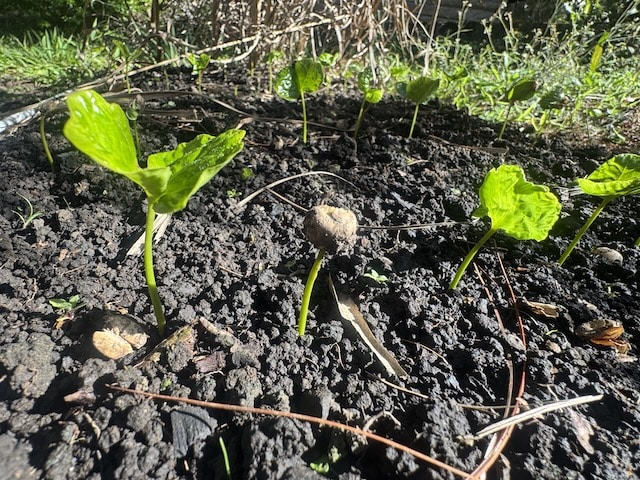
That’s how Mommy Purita, my mother-in-law and the granddaughter of Lola Agnep, has always described the ground we farm on. She didn’t need a soil report or a geology paper to know it. What she has is a lifetime of growing things on this mountainside in Balili, Mankayan, and the certainty of someone whose family has held this land since the early 1900s.
I’m a food technologist by training. When we started Agnep Heritage Coffee in 2018, I wanted to understand what was actually under our feet, and whether Mommy’s plain-spoken description held up.
The geology literature backs up what Mommy has always said. Our farm sits on the weathered remains of a Pliocene-Pleistocene andesite-dacite volcanic system, documented in peer-reviewed mining geology (Hedenquist et al., 1998; Chang et al., 2011). Mankayan is one of the most-mapped mining districts in the Philippines, because the same volcanic system that gives us our soil also hosts the copper and gold deposits at Lepanto, just nine kilometers from our farm in Sitio Bay-o.
Farmer Angie described an inactive volcano in Barangay Tabio, which she calls Posdo. The geology literature documents this as the Posdo Diatreme complex, a maar-diatreme volcanic feature within the Mankayan district (Sillitoe and Angeles, 1985; Sillitoe, 2010). A maar-diatreme is a type of volcano formed when rising magma meets underground water and explodes, leaving a wide, shallow crater at the surface and a deep funnel of broken rock below. Angie didn’t need any of those papers to know what was there. She grew up looking at it.
Two layers of geological history shape what we farm on.
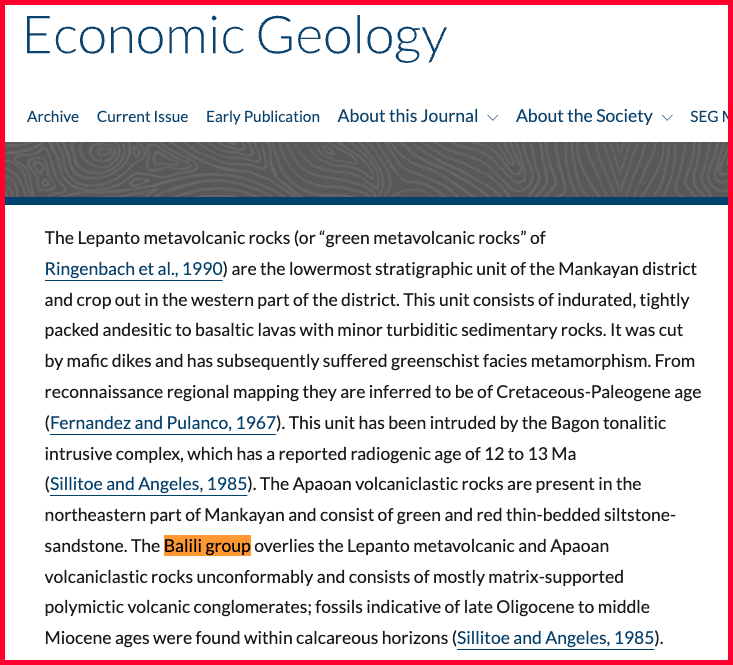
The deeper layer is called the Balili group in the geology literature, and yes, it’s named after our barangay. It’s a rock made of many different kinds of volcanic chunks pressed together with finer-grained material around them, like chunks in concrete. Inside the rock are some calcium-rich layers with fossils preserved in them, and those fossils tell geologists the rock was deposited between roughly 28 and 12 million years ago (Chang et al., 2011, summarizing Sillitoe and Angeles, 1985).
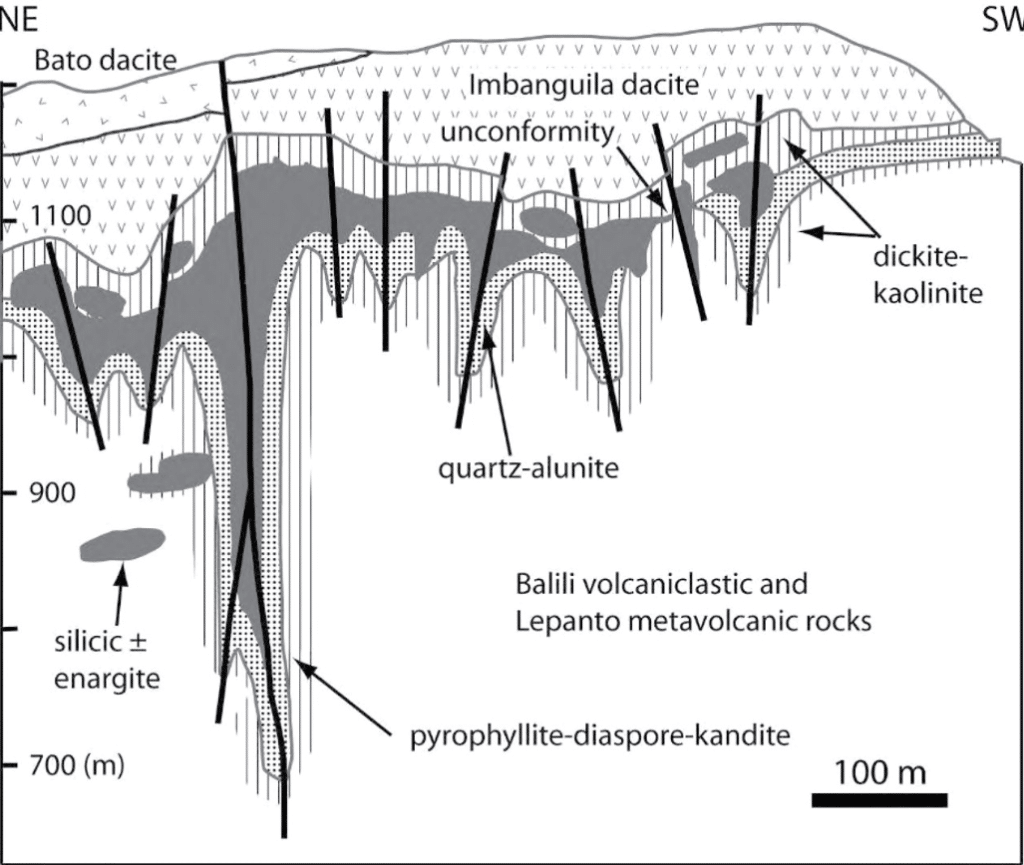
On top of that older rock sit the volcanic units that actually make our soil. Between roughly 2.2 million and 1 million years ago, dacite and andesite eruptions covered this part of Mankayan in fresh volcanic material (Hedenquist et al., 1998; Chang et al., 2011). Weathering of those volcanic rocks contributes to the kind of black, loose ground rich in organic matter that I dig my hands into every harvest.
Now, why does any of this matter for coffee?
Soils that form from volcanic parent material are studied in soil science as Andisols, and they’re documented as having low bulk density, loose friable structure, high water retention with good drainage, and a mineral profile dominated by short-range-order minerals like allophane and imogolite that store and release nutrients differently from the crystalline clays found in non-volcanic soils (Shoji et al., 1993; Dahlgren et al., 2004; Takahashi and Dahlgren, 2016). Whether our specific topsoil formally classifies as an Andisol would take a soil test to confirm, but the texture and drainage we work with every day are consistent with what the literature describes.
I’d be careful claiming any single causal link between volcanic-derived soil and coffee quality, because each farm has its own combination of altitude, climate, varietals, and farming practices. What I can say is that volcanic-derived soil shows up repeatedly in places where Arabica thrives, and our farm is one of them.
What we have on top of that volcanic base is decades of leaf fall from the canopy of native Benguet pine, Kalasan, and Alnus that shades every coffee tree on our farm. Cool altitude generally slows decomposition, so organic matter tends to accumulate faster than it breaks down. The result is the kind of soil Mommy described to us, black and loose, with the kind of life in it you can feel when you reach in.

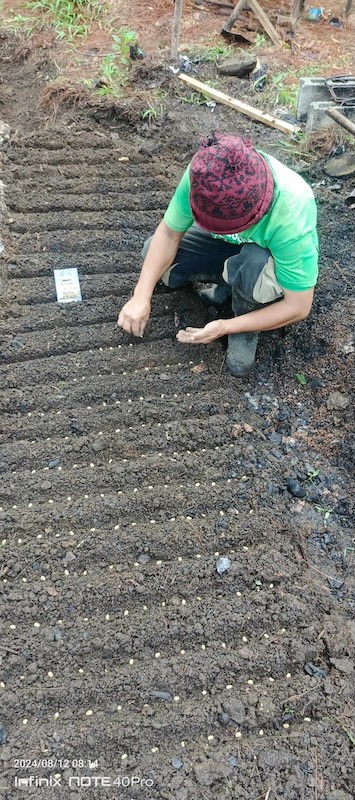
Our farming practice respects what the soil already is. We don’t apply synthetic fertilizers. We follow JADAM, a Korean natural farming method that uses fermented plant material and microbes from our own land to feed the soil. We do this because chemicals would interrupt what the soil and the canopy have been doing here for a long time, and because in our direct observation, the trees and the cherries respond well when we work with the system rather than around it.
There’s something I keep returning to as we build this farm. Mommy didn’t need any of the geology papers to know what she knew. The science I’ve read since is consistent with what farmers who’ve worked this land have always understood through observation and harvest after harvest. My role as farm manager is to make sure we don’t lose what’s already here, and to translate it into language the next generation of farmers and the people buying our coffee can trust.
“The soil on our farm is volcanic.” That’s the first thing Mommy ever told me about it, and the more I learn, the more I see how much was already in that one sentence.
How to cultivate JADAM Microorganism Solution (JMS).-JADAM Organic Farming
Sources
Chang, Z., Hedenquist, J. W., White, N. C., Cooke, D. R., Roach, M., Deyell, C. L., Garcia, J., Jr., Gemmell, J. B., McKnight, S., & Cuison, A. L. (2011). Exploration tools for linked porphyry and epithermal deposits: Example from the Mankayan intrusion-centered Cu-Au district, Luzon, Philippines. Economic Geology, 106(8), 1365–1398. https://pubs.geoscienceworld.org/segweb/economicgeology/article/106/8/1365/151845/Exploration-Tools-for-Linked-Porphyry-andhttps://doi.org/10.2113/econgeo.106.8.1365
Dahlgren, R. A., Saigusa, M., & Ugolini, F. C. (2004). The nature, properties and management of volcanic soils. Advances in Agronomy, 82, 113–182.
Hedenquist, J. W., Arribas, A., Jr., & Reynolds, T. J. (1998). Evolution of an intrusion-centered hydrothermal system: Far Southeast–Lepanto porphyry and epithermal Cu-Au deposits, Philippines. Economic Geology, 93(4), 373–404. https://doi.org/10.2113/gsecongeo.93.4.373
Shoji, S., Nanzyo, M., & Dahlgren, R. A. (1993). Volcanic Ash Soils: Genesis, Properties and Utilization. Elsevier.
Sillitoe, R. H., & Angeles, C. A., Jr. (1985). Geological characteristics and evolution of a gold-rich porphyry copper deposit at Guinaoang, Luzon, Philippines. In Asian Mining ’85: Proceedings of the conference (Conference 2, pp. 15–26). Institute of Mining and Metallurgy.
Takahashi, T., & Dahlgren, R. A. (2016). Nature, properties and function of aluminum–humus complexes in volcanic soils. Geoderma, 263, 110–121.