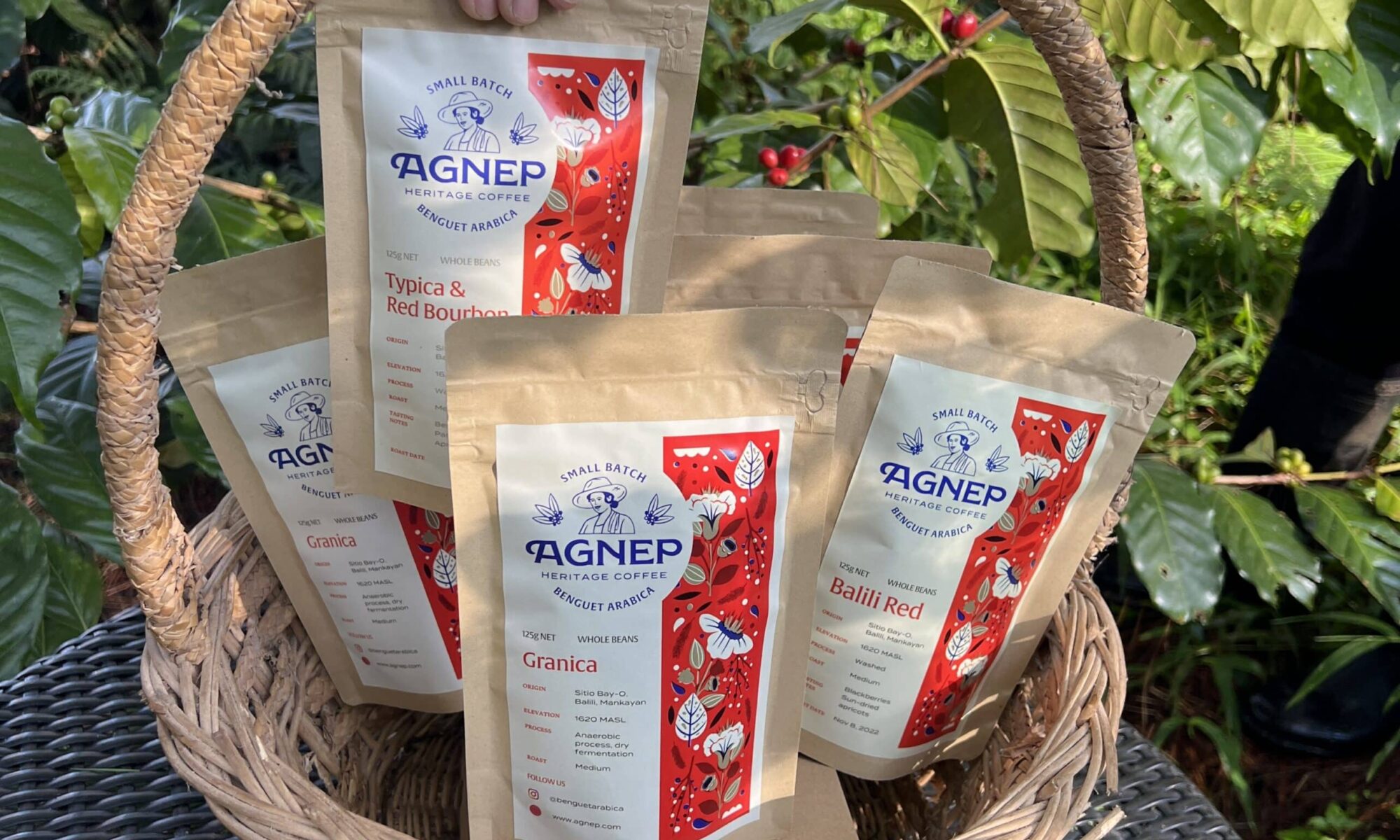
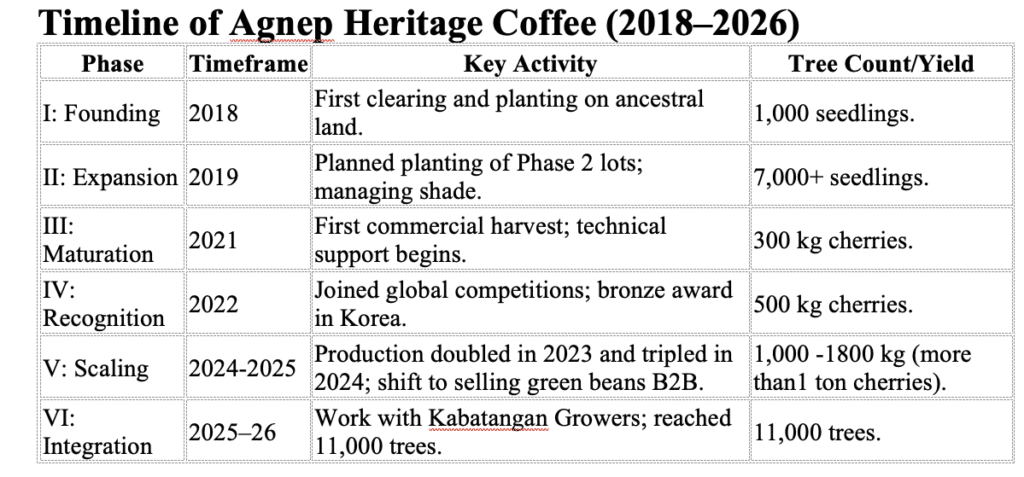
A quick look at how Agnep Heritage Coffee (Agnep) grew from a family farm in Mankayan, Benguet into a high-altitude Arabica producer—shaped by heritage, forest shade, careful processing, and community partnerships (2018–2026).
Agnep Heritage Coffee is one example of how Philippine specialty coffee is starting to get noticed beyond our shores. We’re based in the highlands of Mankayan, Benguet, and our work sits between two things we value: indigenous knowledge carried through generations, and the tools and methods of modern agriculture.

From 2018 to early 2026, Agnep grew from a family project into a small-batch coffee producer of high-altitude Arabica that has earned recognition outside the Philippines. This also happened within a bigger national reality: the country still can’t produce enough coffee to meet local demand. Roughly 70% of demand still isn’t covered by local supply, so farms like ours have more reason to build value through specialty coffee than to chase volume and price like commodity coffee.
What Agnep is built on
Agnep Heritage Coffee was never meant to be “just a business.” It’s tied to Cordillera history and to the way people here have held on through change and disruption. The farm carries the name of Agnep, a Bontoc native and the great-great-grandmother of today’s owners, who planted coffee in the backyard of her ancestral land in the early 1900s.

That family line shapes how we work today. For us, coffee isn’t only a crop—it’s also part of caring for land, and protecting culture while we build something that lasts.
A short story from Benguet’s coffee history
Coffee in Benguet comes with a history of resistance—people still talk about it when they talk about how coffee took root here. The 1903 Census of the Philippine Islands notes that during the Spanish period, coffee became a point of tension. In 1888, a Spanish governor pushed to expand coffee planting in Benguet to raise colonial income. There was strong resistance, especially in Daklan, where indigenous residents tried to destroy coffee trees to push back against colonial control.
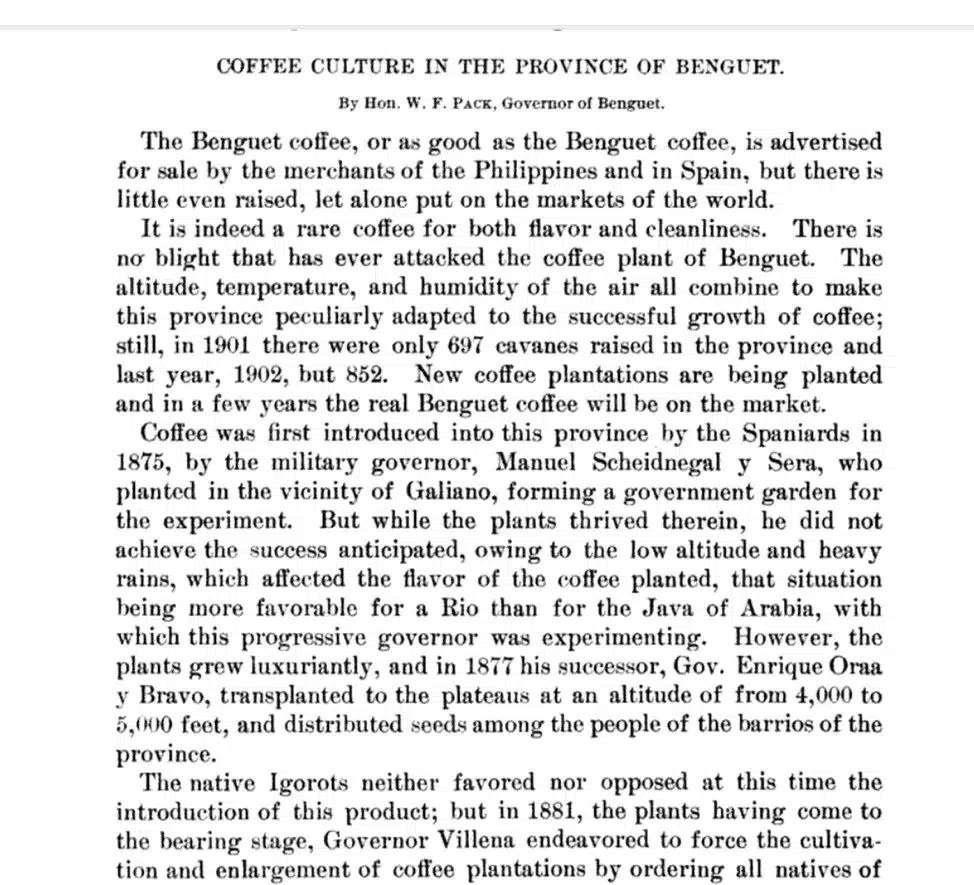
But coffee trees can be stubborn. They grew back even after being cut down. Local historians often read that as a symbol: coffee culture here continued, even when life got difficult.
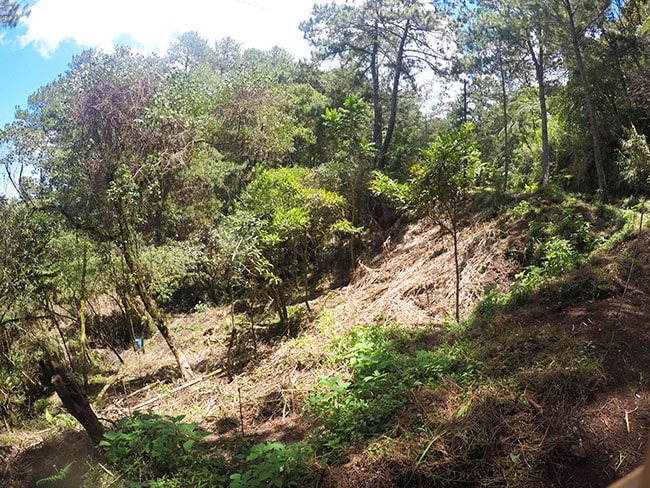
By January 2018, the Dado family—led by Noemi Lardizabal-Dado and her two daughters and husband—formally established the farm. It didn’t feel like starting from zero. It felt more like picking up a tradition that had made it through more than a century of neglect and disruption. And it began with one simple question: what can we do with our ancestral land in Sitio Bay-O, Mankayan?
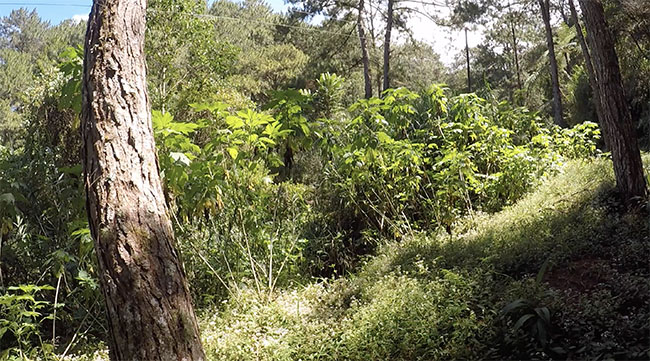
At the time, it was about five hectares of idle forest land, mostly pine trees and kalasan. Over time, it became the site of a planned effort to plant coffee.
Why this place matters: altitude, forest cover, and the cup
A big part of Agnep’s quality comes down to place. That’s terroir—soil, climate, slope, and the wider environment of the Cordillera mountains. The farm sits at 1,620 meters above sea level (MASL), which places it among the higher coffee-growing areas in the Philippines.
Altitude and bean density
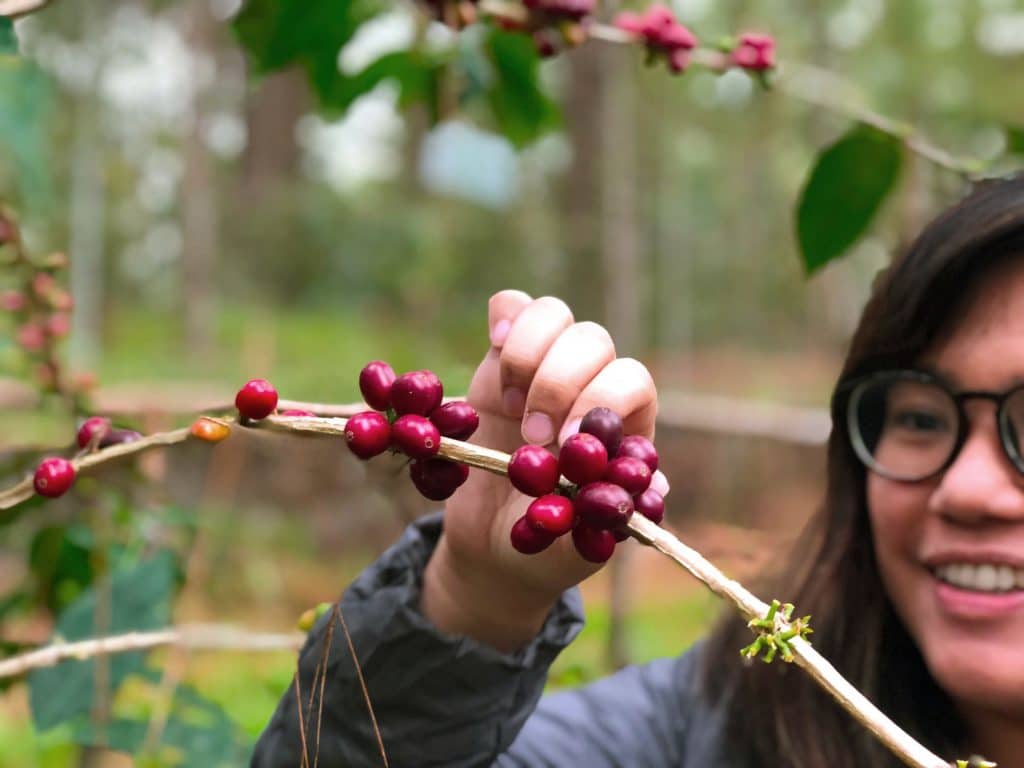
At 1,620 MASL, Arabica behaves differently than it does in the lowlands. It’s cooler up here, and that slows plant growth. The cherries ripen more slowly too, which gives more time for sugars and acids to develop inside the bean. Those compounds shape the “sweet and bright” profiles specialty roasters look for, with tasting notes often described as citrus, jasmine, and bergamot.
A shade-grown, forest-style farm
Agnep is managed more like a forest than a classic plantation. Our coffee isn’t planted out in wide, open rows under full sun. It grows under a living canopy—Benguet Pine (Pinus insularis), kalasan, and alnos—so the farm feels more like forest than plantation.
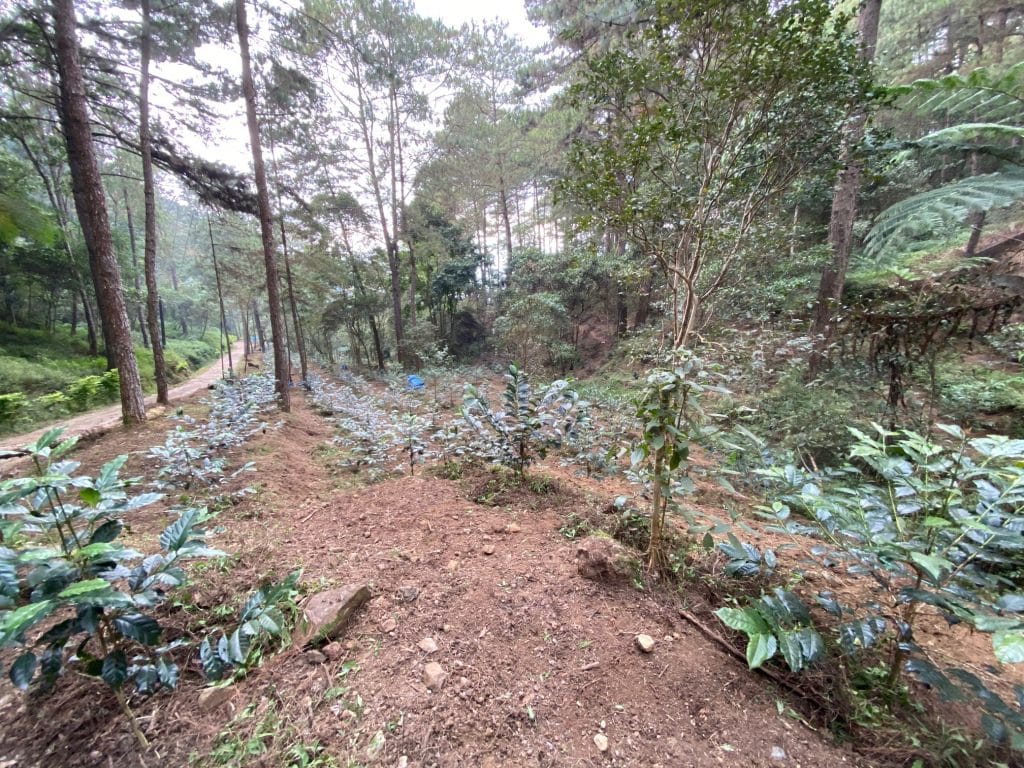
We keep roughly 40% shade, and you can feel the difference when you’re walking the blocks:
Microclimate: The canopy softens the heat and keeps the air from drying out too fast. That extra humidity matters during the dry harvest months, December to April.
Soil: On steep slopes, roots are your best “net.” With different trees anchoring the slope, the soil is less likely to slip. Leaf litter builds up, breaks down slowly, and feeds the soil as it goes.
Water: The forest floor works like a sponge. It holds on to moisture, helps protect water sources, and reduces contamination risk—especially in watershed-protected parts of the Cordilleras.
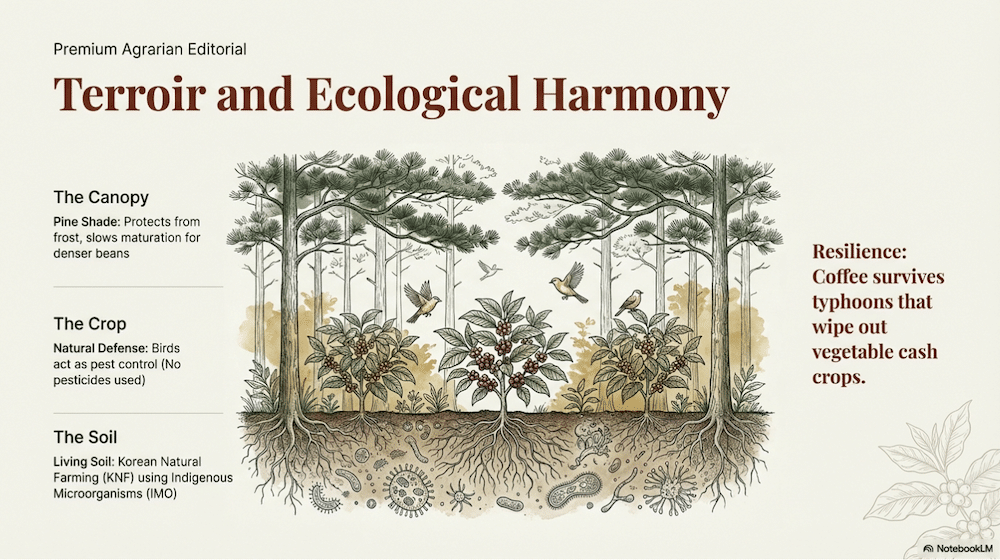
Biodiversity as natural pest control
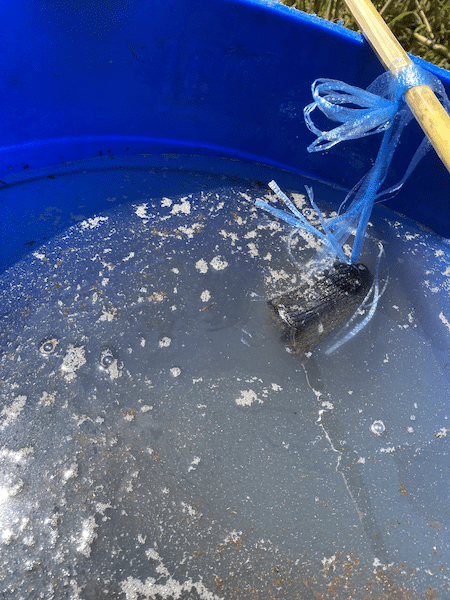
We don’t use chemical pesticides . We rely on what’s already in the environment, and we support it. Birds in the canopy help keep pests from building up, and bees do the steady work of pollination. We also use indigenous microorganisms and organic inputs like JADAM microbial solution or JADAM liquid fertilizer to keep the soil active and healthy. When soil life is strong, the plants usually follow—better growth, and a more natural ability to resist disease.
Varietals: how we build quality through plant choice
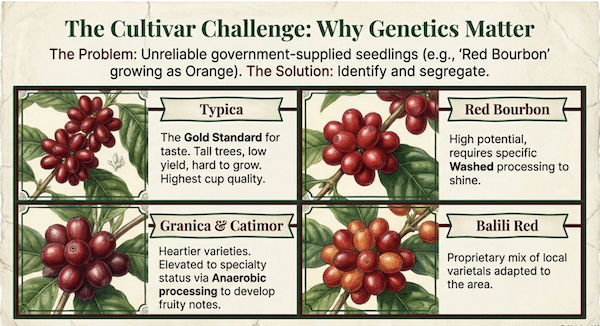
Agnep focuses on Arabica varietals that are suited to Benguet’s high-altitude conditions. We don’t put all our eggs in one basket either. Growing more than one varietal spreads risk, and it gives us a wider range of flavor profiles to offer the specialty market.
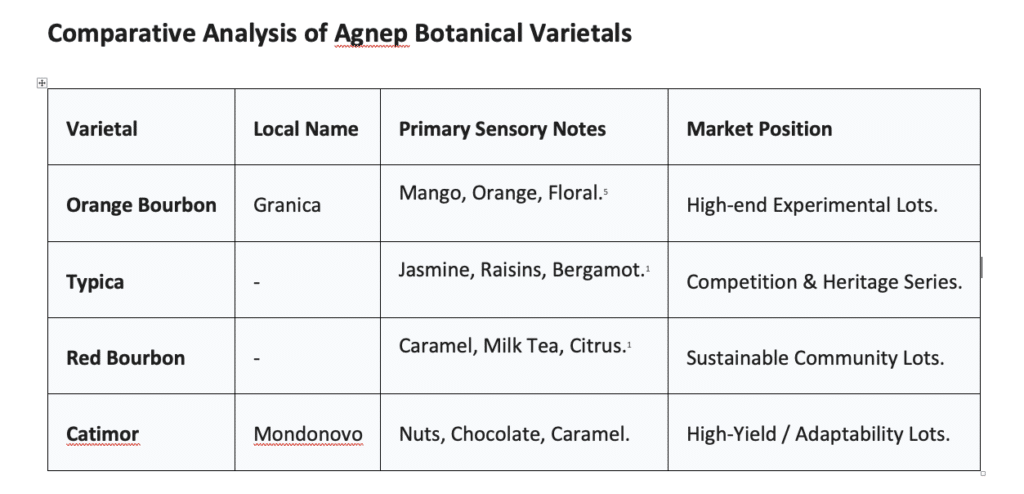
Orange Bourbon (Granica)
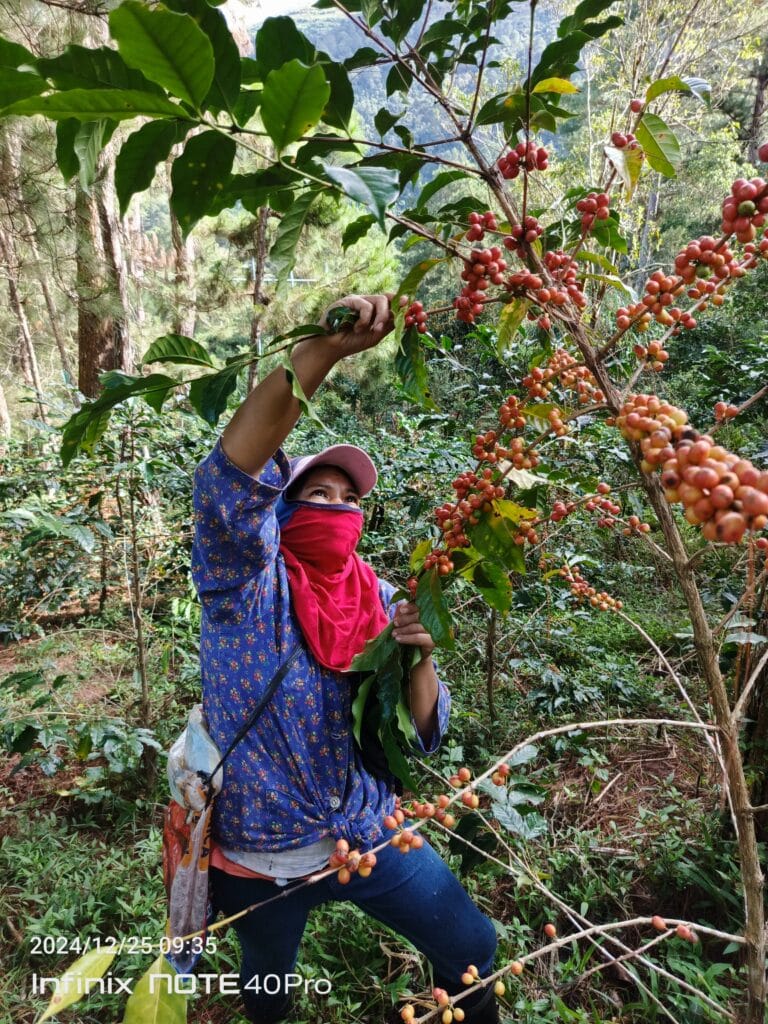
The standout varietal is Orange Bourbon, locally called Granica. Bourbon types are known for sweetness and lively acidity, and the orange mutation is especially valued for tropical fruit character. At Agnep, Granica has shown a strong ability to express the Mankayan growing conditions—especially when paired with experimental processing methods.
Typica and Red Bourbon
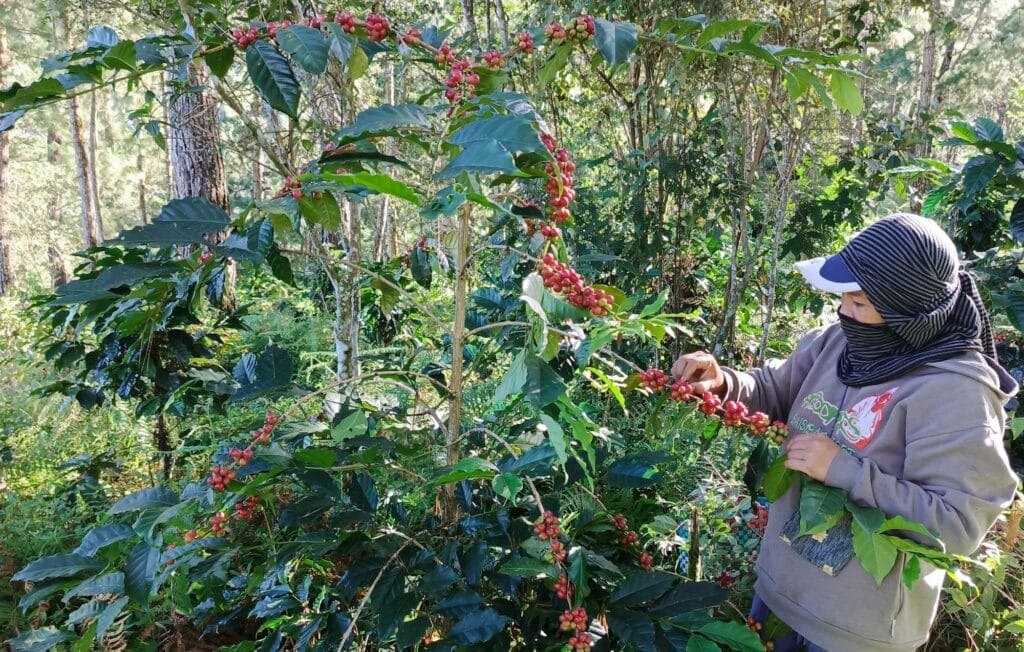
Alongside Granica, we also grow Typica and Red Bourbon. Typica is one of the oldest Arabica varieties, and many people treat it as the baseline for a clean, balanced cup. For us at Agnep, Typica was the varietal we leaned on in our early competition entries—and it ended up winning awards. It’s a good reminder that the classics still deliver, as long as you grow them well and take care of them after harvest.
Catimor (Mondonovo)
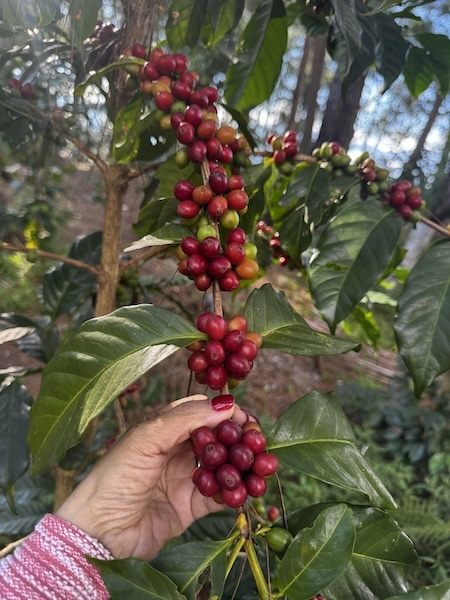
The farm also cultivates the Catimor varietal, a hybrid locally known as Mondonovo. This variety is a cross between Caturra (a high-yield Arabica) and the Timor Hybrid (a natural Arabica-Robusta blend recognized for its resistance to coffee leaf rust). The Catimor trees at Agnep reach a compact height of 3 to 5 feet, which facilitates high-density planting and ease of maintenance. They are distinguished by wide, oblong leaves and high productivity, often bearing 18 to 20 cherries per node. In the cup, the Agnep Catimor offers balanced flavors characterized by notes of nuts, chocolate, and caramel.
Post-harvest work: where the details show up
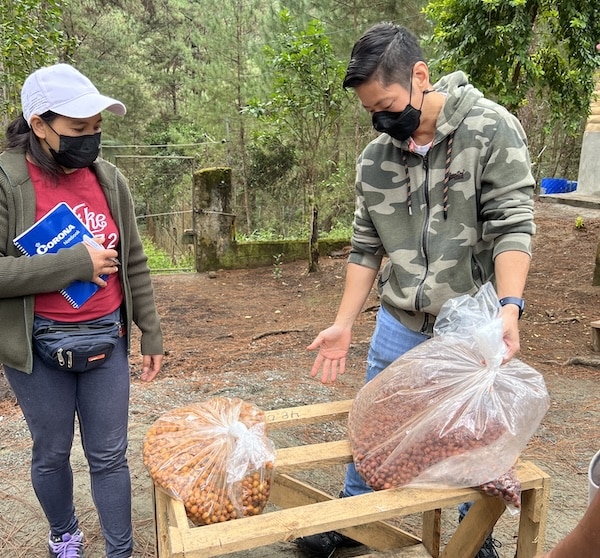
Agnep’s move from strong farm output to wider recognition didn’t happen by accident. A big part of it was post-harvest work—better tools, better control, better decisions. One key piece was working with Michael Harris Conlin, the 2019 and 2025 Philippine National Barista Champion and CEO of Henry & Sons.
Fermentation as a value builder
Coffee is a long-term crop; it often takes around five years from planting to full production. So if you’ve made that investment, you want to protect and elevate the result. Agnep uses fermentation methods to influence the bean’s chemical development and create flavor profiles that can sell at higher prices.
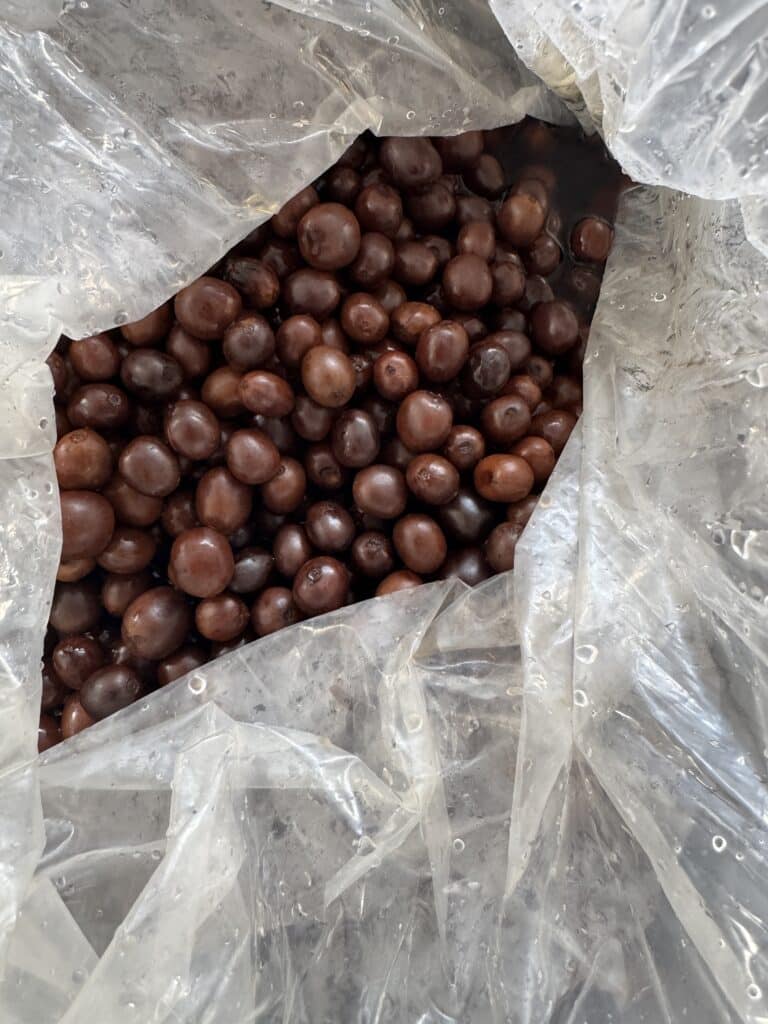
One method used is anaerobic dry fermentation. Ripe cherries are placed in sealed containers—no oxygen, no water. In that closed environment, microbes behave differently than they do in open-air fermentation. That changes enzyme activity, and it shifts the flavor outcome. With Granica, this usually brings out more fruit character and gives a cup that feels more layered than a standard washed Arabica.
When to keep it simple
The 2022 competition season reinforced something important: terroir and processing have to match. Conlin observed that because Agnep coffee is grown in a healthy, forest-style system, an “ultra minimalist” processing method often worked best for Typica. It preserves terroir-driven flavors—what the soil, climate, and altitude naturally bring—without burying them under heavy fermented notes from more aggressive methods. Knowing when to intervene, and when to back off, is part of advanced specialty work.
International recognition (2022)
Agnep’s work got international validation in late 2022. With Michael Harris Conlin representing the farm, Balili Benguet Arabica was entered into the Global Coffee Championship in Korea.

The event used blind judging and involved 12 coffee experts. Against more than 30 entries from established coffee origins, Agnep won the Bronze Award in the Signature Coffee Award – Brewer category. For the Cordilleras, that mattered—it showed that Philippine specialty coffee can meet international sensory standards.
Community impact: growing beyond our own farm
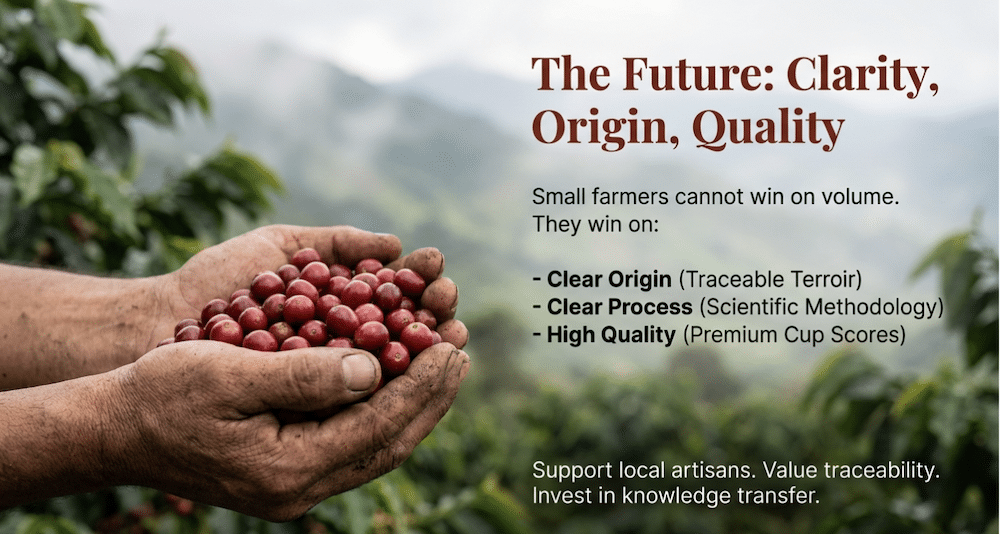
Long-term sustainability isn’t only about trees and processing. It’s also about people. In the Philippines, around 80% of coffee is produced by smallholders working one to two hectares. Agnep positions itself as a “nucleus farm,” meaning the farm aims to strengthen nearby growers, not operate in isolation.

A key part of that mission is the partnership with Kabatangan Coffee Growers, a farmer group in Benguet. Noemi Dado and the team share knowledge on shade-grown farming and sustainable practices. The direction is clear: encourage farmers to supplement their chemical-heavy vegetable farming—fast harvest cycles (2–3 months), but long-term soil damage—and toward higher-value, longer-term coffee farming. The goal is a steadier local farm economy that can hold up over time.
Market approach (2024–2026)
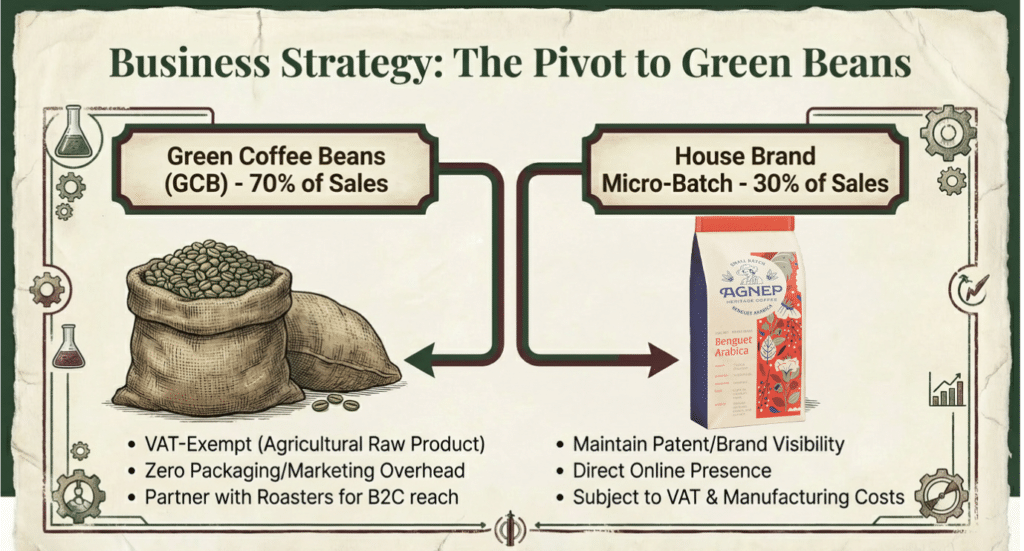
Agnep’s business approach changed as the market shifted. The farm started by selling roasted beans directly to home brewers, then later made a significant pivot.
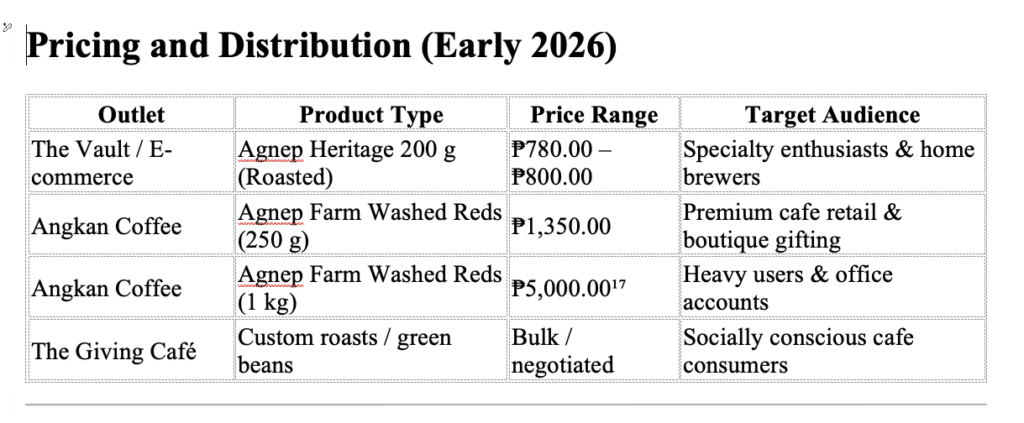
By 2024, production reached about one ton of coffee cherries. At the same time, the farm saw that the local market for premium roasted coffee (around ₱780–₱800 per 200 g) was limited, because fewer high-end home brewers were buying regularly. So Agnep started selling green (unroasted) beans to specialty cafés in Manila, including Angkan Coffee Company ,The Giving Café or thevault.ph and The Good Cup Coffee. In 2025, those three buyers accounted for about 60% of Agnep’s harvest.
Agnep also strengthened credibility through regulatory steps:
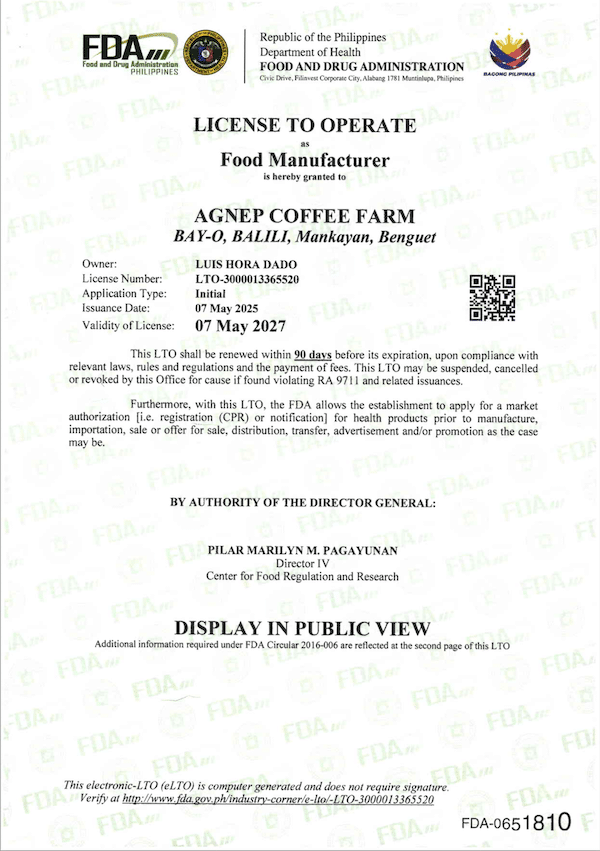
FDA licensing: Agnep Heritage Coffee (under Agnep Coffee Farm) received a Food Manufacturer license from the Philippine FDA on May 7, 2025.
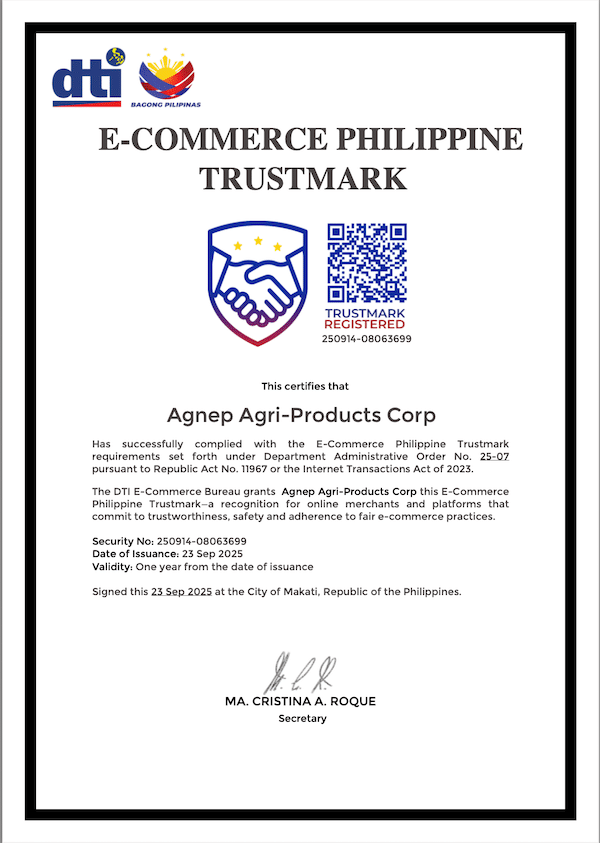
E-Commerce Trustmark: The farm aligned with the DTI E-Commerce Philippine Trustmark, a voluntary badge for safety and fair trade standards. It remains voluntary for micro-enterprises until December 31, 2026, but adopting it supports safer online selling and improves credibility.
Looking ahead: coffee in the 2026 economy
Early 2026 brings a mixed picture. The Philippine economy slowed to 4.4% growth in 2025, the slowest in five years, and that kind of slowdown usually affects spending on premium products.
Still, specialty coffee can remain steady because many people treat it as a daily habit, not a one-time luxury. And supply is limited by nature. Philippine-grown coffee meets only around 38% of national market needs, so high-quality local beans like Agnep’s can stay in demand even when conditions tighten.
Where this leaves us
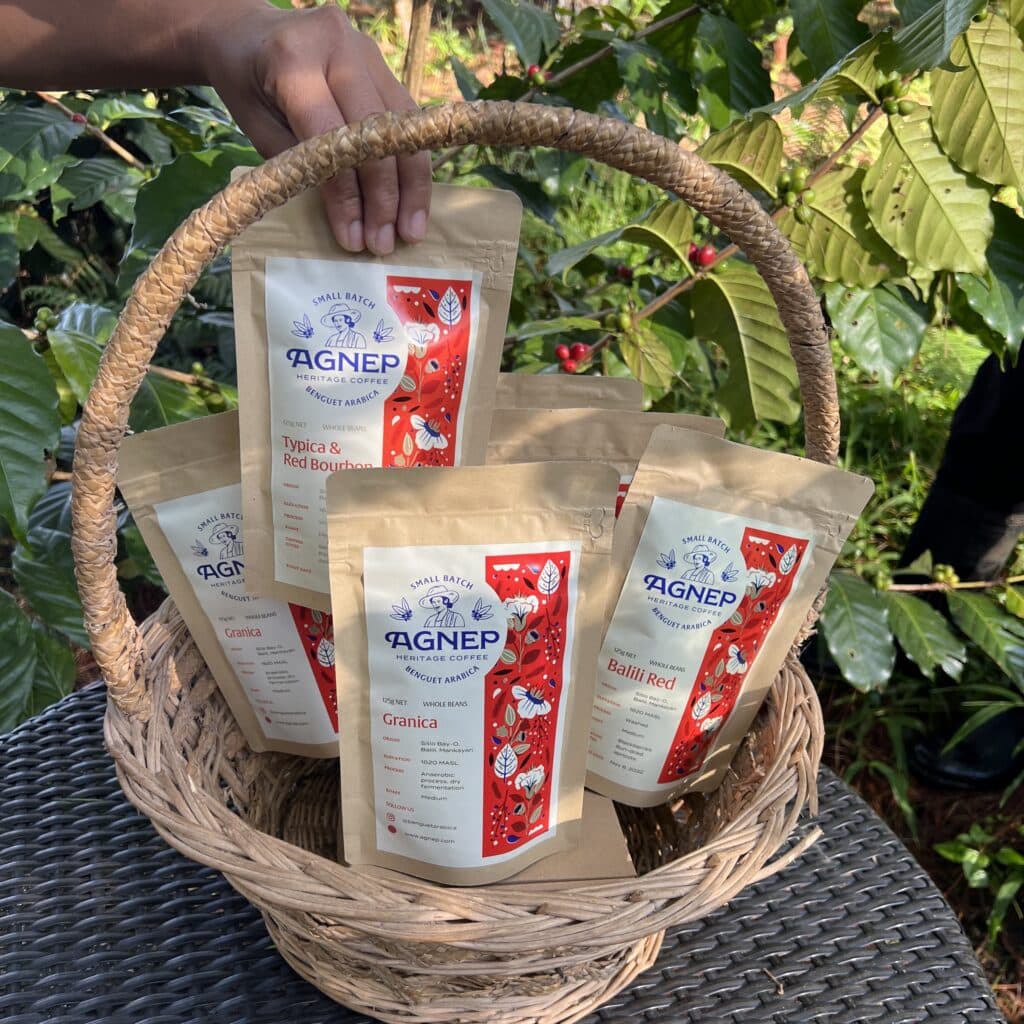
Agnep Heritage Coffee offers a practical model for sustainable growth in Philippine coffee. By combining family heritage with advanced fermentation work and stronger B2B partnerships, the farm has addressed barriers that many small producers in Benguet face. Its international results, along with the work with Kabatangan Coffee Growers, point toward a future built on high-value, shade-grown specialty coffee—coffee that respects both the land and the people who farm it. And as climate and economic conditions keep shifting, the Agnep approach gives a steady reference point for quality, technical progress, and long-term stability.
Want to work with us or learn more about our lots?
Explore our coffee, our processes, and our story here on the site.