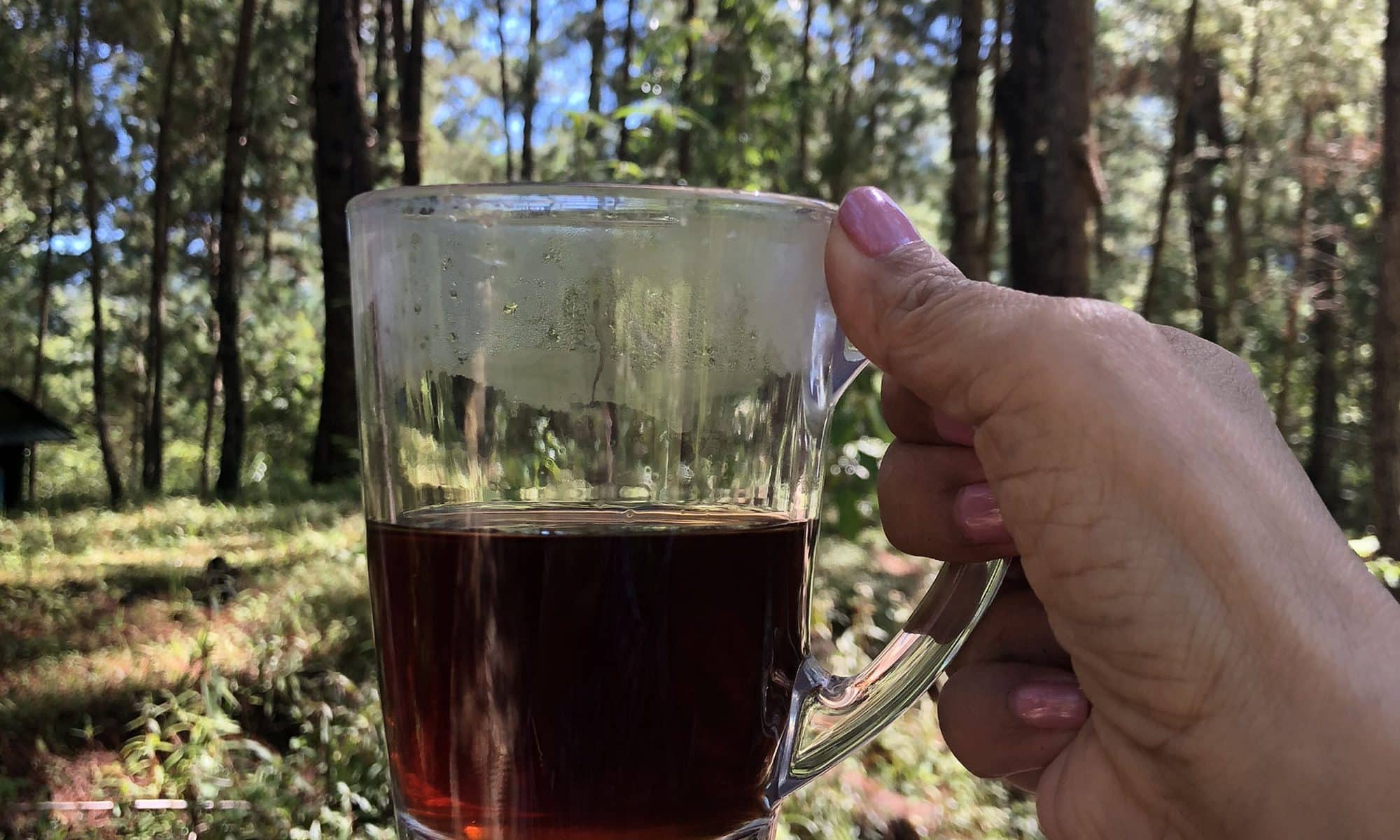
Ask most people how Filipinos resisted colonial rule and the story heads straight for the lowlands, for Rizal, for the Katipunan meeting in secret. The Cordillera was living out a quieter history the textbooks mostly skip, and a good part of it came down to a fight over one crop. That crop was coffee, and the closest anyone came to a weapon was a pot of boiling water.
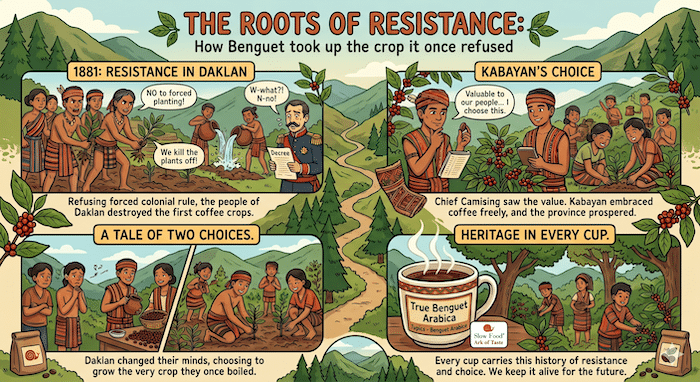
In 1881 the colonial government decided these mountains would grow coffee whether the people wanted to or not. One village refused, and rather than be told what to put in their own ground, they killed the plants off. What came later is the better part of the story. That same coffee found its way back years on, except this time nobody forced it. The community grew it because they chose to.Take away everything else and the story of Benguet Arabica comes down to one question: who gets to decide what grows on a mountain, and on whose terms.
Coffee was not new to these mountains by 1881. William F. Pack, the American governor of Benguet, set the history down in the 1903 census of the islands. A Spanish military governor, Manuel Scheidnegal y Sera, brought the first arabica to the province in 1875 and planted it near Galiano in a government garden, where the low ground and heavy rain spoiled the flavor. Pack wrote that the wet lowland site favored a coarser Rio coffee over the Java of Arabia, his name for the fine arabica the governor was experimenting with. His successor, Enrique Oraa y Bravo, carried the plants up to the plateaus, four to five thousand feet, in 1877 and handed seeds out to the barrios, and this time the coffee took.
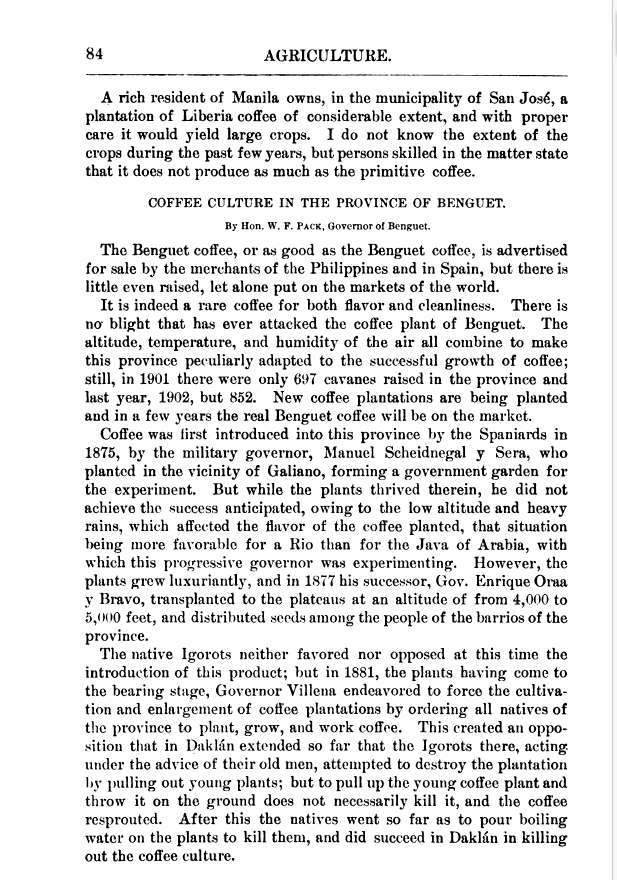
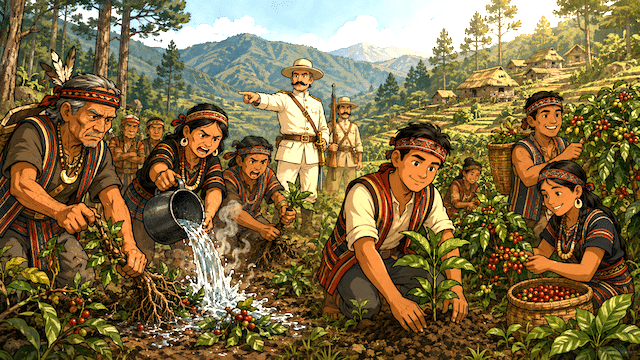
The trouble came in 1881, once the plants were old enough to bear. Governor Villena ordered every native in the province to plant, grow, and work coffee. In the village of Daklan the people refused. On the advice of their old men they pulled the young plants out of the ground, but coffee is stubborn, and the uprooted plants only resprouted. So they went further and poured boiling water over them until the coffee was dead. In Daklan they killed the culture off completely.
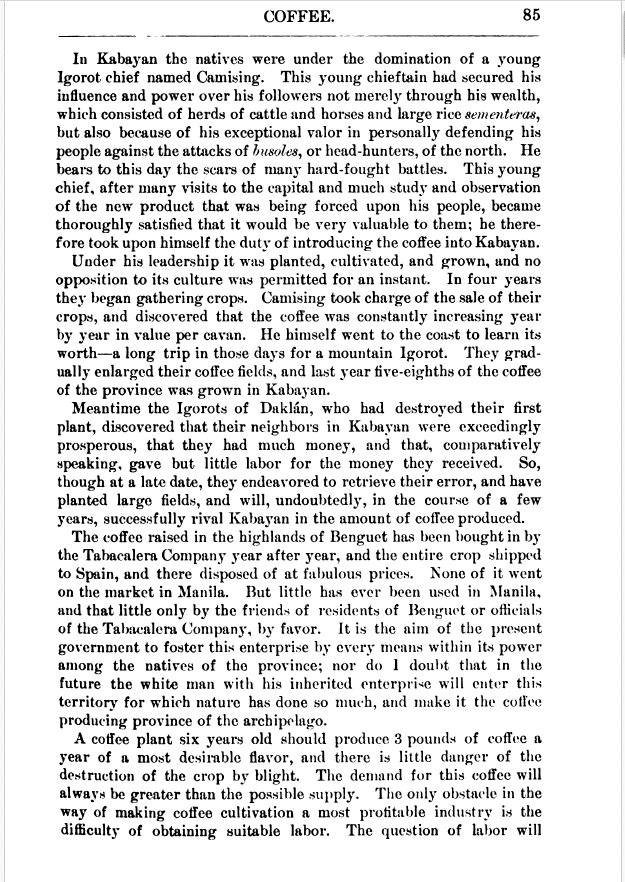
Coffee found its footing by another route. In Kabayan a young chief named Camising had watched the crop being forced on the region and studied it for himself, traveling to the capital and weighing what it might be worth. By Pack’s account he came to believe it would be valuable to his own people, so he took it up by his own choice and led the planting in Kabayan, where no one opposed it. Within four years they were harvesting, and before long Kabayan grew five-eighths of the province’s coffee. The people of Daklan, watching their neighbors prosper, changed their minds and planted it too. The same crop they had once boiled out of the ground, they now grew because they wanted to.
You can taste the long tail of that choice today. Benguet coffee now sits on the Slow Food Foundation’s Ark of Taste, an international register of heritage foods in danger of vanishing. It is there because it is at real risk. The old trees are thinning out as fewer young people stay to farm them, and a shifting climate adds to the pressure. The variety on the list is Typica, the same Arabica that has grown on these slopes for well over a century.
Every cup of true Benguet Arabica carries that history in it. It is a crop the mountains once destroyed rather than be ordered to grow, and later took up freely once the choice was their own. We are still growing it, on the same kind of high, shaded ground where it first proved it could thrive, and the work now is to keep it alive for the people who come after us.
—
Source: W. F. Pack, “Coffee Culture in the Province of Benguet,” in Census of the Philippine Islands Taken in the Year 1903, Vol. IV: Agriculture, Social and Industrial Statistics (Washington: US Bureau of the Census, 1905), 84-86.